
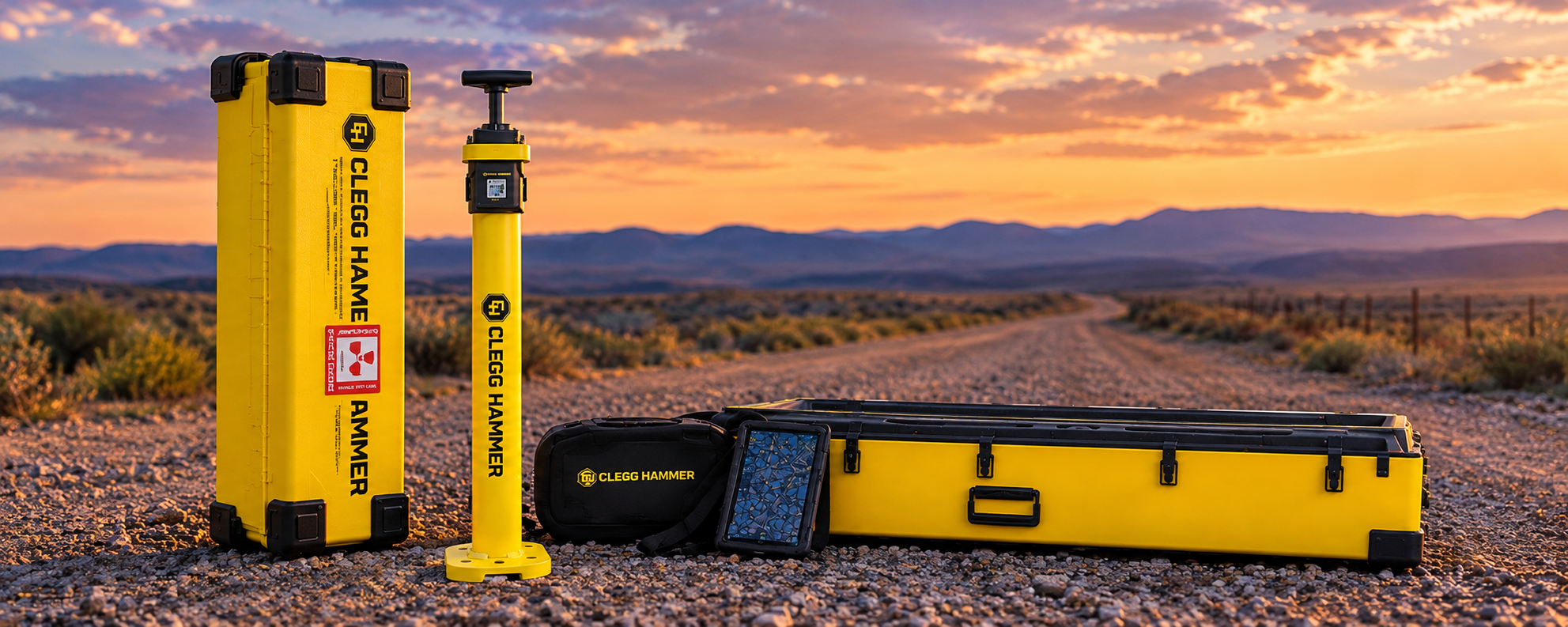
Soil Compaction Testing Equipment
Soil Compaction Testing Equipment
A result in the time it takes to read this sentence.
The Clegg Hammer drops a weighted mass down a guide tube, reads the deceleration on impact, and returns an Impact Value that reflects the strength and stiffness of the ground beneath it — no radioactive source, no lab wait.
The Basics
What is soil compaction testing?
It's how you confirm soil or aggregate has actually achieved what the project spec requires — before it's buried under pavement or a foundation.
Compaction changes how soil particles are arranged, and that can affect far more than one number:
Density
Strength
Stiffness
Bearing capacity
Compressibility
Stability
Moisture response
Pavement performance
A soil can hit its target density while its strength still varies with moisture, material type, or what's underneath. That's the gap in-situ Impact Value testing is built to close — and why some specs pair density-based QC with a strength or stiffness check.
Equipment
Soil compaction testing equipment: what are your options?
Each method measures something different, with its own advantages and limits depending on the project. None are interchangeable.
| Testing method | Primary measurement | Field use | Nuclear Source | Strength/Stiffness information | Typical application |
|---|---|---|---|---|---|
| Nuclear Density Guage | Density and Moisture | Yes | Yes | Indirect | Compaction specifications |
| Sand cone | Density | Yes | No | Indirect |
Traditional field density testing |
| Electrical Density Guage | Density/Moisture related properties | Yes | No | Indirect | Non-nuclear density testing |
| Light Weight Deflectometer | Delection/Modulus | Yes | No | Yes | Pavement and subgrade evaluation |
| Dynamic Cone Penetrometer | Penetration Resistance | Yes | No | Yes | Subgrade and soil profiling |
| Clegg Hammer | Impact Value | Yes | No | Yes | Rapid strength/stiffness and compaction assessment |
Field vs. lab
Why test soil compaction in the field?
Lab testing establishes what a material can be — field conditions decide what it actually is.
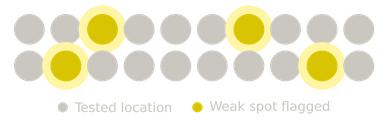
Testing more locations gives you a real picture of uniformity across a job that can run thousands of square feet — or acres. Field testing is how you find:
Areas of inadequate compaction
Variations between test locations
Weak areas within otherwise acceptable material
Changes in material performance
Effects of moisture
Areas needing additional compaction
Differences between lifts or sections
Changes in road base or subgrade performance
The Clegg Hammer is built around this: Clegg reports results on the tablet within roughly two seconds of a drop, so a single operator can cover many locations in a short window of time.
Properties
Density, strength and stiffness aren't the same thing
Understanding what a test actually measures is the most important decision in selecting equipment.
Density
How much mass sits within a given volume — measured by nuclear gauges and sand cone testing.
Strength
The material's ability to resist applied force without failing.
Stiffness
How the material responds to deformation under loading.
These properties are related, but not identical. A soil can hit its target density while strength or stiffness still varies with moisture, material characteristics, and what's underneath — which is why some projects pair density-based QC with an in-situ strength or stiffness check. ASTM D5874 describes Impact Value as a dynamic force-penetration property usable as a strength parameter.
How it works
What is a Clegg Impact Value?
A controlled mass falls through a guide tube and strikes the surface. An accelerometer in the hammer measures the peak deceleration on impact — that reading is the Clegg Impact Value (CIV), also called Impact Value (IV).
Per ASTM D5874-24: the standard instrument is a 4.5 kg hammer dropped from 450 mm. ASTM describes Impact Value as representing both stress and penetration, and as a direct measure of stiffness or strength. Equipment configurations vary by material strength range and testing objective.
Interpretation
What does a Clegg Hammer measure?
Impact Value responds to several physical characteristics of the material, so a result should always be read in context.
Material type
Particle grading
Layer thickness
Density
Moisture condition
Underlying material
Important: the Clegg Hammer does not directly report a percentage of Proctor compaction. Impact Value functions as a strength index — ASTM D5874 provides procedures for relating it to unsoaked CBR, or inferring percentage compaction, once a lab correlation exists for that particular soil.
Compaction control
Clegg Hammer for compaction control
Used as part of a compaction-control program across:
Road construction
Subgrade
Trench Reinstatement
Pavement construction
Earthworks
Road construction
Road base
Foundations
Mining Construction
Setting a target value
For projects using a strength-based acceptance criterion, a target Impact Value can be established for the specific material and moisture conditions through lab testing or field trials — complementing, not replacing, a conventional density spec.
Why speed matters
Why use rapid field compaction testing?
Testing only a handful of locations makes it hard to see variation across a large project. More locations, more confidence.
Weak spots
Inconsistent compaction
Changes in material
Problem areas near structures
Areas requiring additional rolling
Variations between lifts
Localized moisture-related problems
Clegg reports results in approximately two seconds after each drop — built specifically for covering more ground per operator, per day.
Comparison
Clegg Hammer vs. nuclear density gauge
Different instruments, different questions. A nuclear gauge determines density and moisture using a radioactive source; the Clegg determines Impact Value without one.
Clegg Hammer
VS.

Nuclear Density Gauge
| Clegg Hammer | Nuclear Density Gauge | |
|---|---|---|
| Primary result | Impact Value | Density / moisture |
| Strength/stiffness response | Yes | Not directly |
| Radioactive source | No | Yes |
| Rapid field testing | Yes | Yes |
| Many locations | Yes | Yes |
| Direct density measurement | No | Yes |
| CBR correlation | Possible, with correlation | Not the primary output |
| Compaction inference | Possible, with correlation | Direct density measurement |
A Clegg Hammer isn't automatically a one-for-one replacement when a spec specifically requires density — the two methods serve different objectives. For non-nuclear field strength or stiffness assessment, the Clegg is another option worth having.
Comparison
An LWD applies a defined loading impulse through a plate and evaluates surface deflection to derive a stiffness-related parameter. The Clegg Hammer measures impact deceleration directly and reports Impact Value. Both provide useful field performance data — the right device depends on the project's testing requirements and specification.
Clegg Hammer vs. Light Weight Deflectometer
Clegg Hammer
VS.

Light Weight Deflectometer
| Clegg Hammer | Light Weight Deflectometer | |
|---|---|---|
| Primary result | Impact Value | Deflection / modulus |
| Measurement principle | Controlled falling mass; accelerometer measures peak deceleration on impact | Defined loading impulse; surface deflection is evaluated |
| Strength/stiffness response | Yes | Yes (derives a stiffness-related parameter) |
| Radioactive source | No | No |
| Field use | Yes | Yes |
| Direct density measurement | No | No |
| Typical application | Rapid strength/stiffness and compaction assessment | Pavement and subgrade evaluation |
| Choose when the spec requires | Impact Value as a strength index | A specific modulus measurement |
Clegg Hammer vs. Dynamic Cone Penetrometer
Comparison
A DCP measures penetration resistance as a cone is driven into the material, giving information about property changes with depth. A Clegg test is a rapid surface measurement. The two answer different questions and are often complementary rather than interchangeable.
Clegg Hammer
VS.
Dynamic Cone Penetrometer
| Clegg Hammer | Dynamic Cone Penetrometer | |
|---|---|---|
| Primary result | Impact Value | Penetration resistance |
| Measurement principle | Controlled falling mass; accelerometer measures peak deceleration on impact | Cone is driven into the material; resistance to penetration is measured |
| Depth information | Rapid surface measurement | Shows changes in material properties with depth |
| Strength/stiffness response | Yes | Yes |
| Radioactive source | No | No |
| Field use | Yes | Yes |
| Direct density measurement | No | No |
| Typical application | Rapid strength/stiffness and compaction assessment | Subgrade and soil profiling |
| Choose when the spec requires | Impact Value as a strength index | A depth profile |
| Use together? | Complementary: fast surface coverage | Complementary: depth profile |
Application
Soil compaction testing for roads and pavements
Road construction is one of the primary applications for field compaction testing.
Where it applies
Subgrade, subbase, aggregate base, stabilized materials, gravel roads, shoulders, pavement construction, reconstructed pavement, and utility trench restoration.
The Clegg Hammer was originally developed for pavement-related applications and has since expanded into broader earthworks and compaction-control work. Because results come back fast, it's practical to test far more locations and flag where additional investigation or corrective work is needed.
Application
Soil compaction testing for gravel and unsealed roads
Where it applies
Road base, subgrade, gravel material, compaction uniformity, weak areas, and construction quality — especially across large or remote sites.
Gravel and unsealed roads can be difficult to evaluate with conventional methods when projects cover large areas or sit in remote locations. A portable field device is especially valuable where hauling larger equipment, or setting up frequent conventional density-testing points, isn't practical.
Application
Soil compaction testing for trench backfill
Where it applies
Utility trench reinstatement — multiple lifts of backfill, each one a chance for inadequate compaction to cause settlement or pavement problems later.
Clegg's compaction-control guidance specifically names trench reinstatement as an application. Testing helps evaluate the compacted material and pinpoint locations that may need additional work before the surface goes back down.
Correlation
Using Clegg Impact Value with CBR
Impact Value and California Bearing Ratio are different measurements, but ASTM D5874 allows correlation between the two when lab correlations are developed for a specific soil.
Impact Value → CBR
The correlation formula used combines the average of in-lab and in-field results. For the most accurate correlation, each site can be established per soil through laboratory correlation — material type, moisture and procedure all shift the relationship, so it should never be assumed universal.
Selection
How to choose soil compaction testing equipment
Work through what the project actually needs to measure before picking a device.
Do you need density?
If the spec requires direct density and moisture, a density-testing method may be the right primary tool.Do you need strength or stiffness?
That's a different question than density, and needs a different test.Do you need many locations?
Rapid testing equipment makes a larger sample size practical.Working remotely?
Portability and field logistics start to matter more.Is the material moisture-sensitive?
Strength and stiffness readings can shift with moisture — account for it in procedure and interpretationWhat does the spec require?
Always verify the governing project specification and standard before choosing a method.
Good fit for a Clegg Hammer
Rapid field measurements, portability, immediate results, large numbers of test locations, strength/stiffness data, non-nuclear testing, remote sites, and trench reinstatement — anything wanting more than density alone.
Consider another method
When the spec requires direct density, a moisture reading in the same test, a depth profile, or the material sits outside your hammer's range.
Standard
ASTM D5874 and Clegg impact testing
ASTM D5874-24 is the current active standard for determination of Impact Value of soil, covering field and lab procedures for pavement materials, soils, soil-aggregates, stabilized soils, and earthworks compaction control.
4.5 kg
The standard configuration — unsaturated compacted fill, particles under 37.5 mm. Measures up to 8 inches (200mm) of well compacted material.
Questions
Frequently asked questions
-
It depends on what the project needs to measure. Nuclear density gauges and sand cone equipment handle density; devices like Clegg Hammers, LWDs and DCPs give different types of strength, stiffness or penetration information.
-
It depends on the tester. Density gauges measure density and, on some devices, moisture. A Clegg Hammer measures Impact Value, related to the material's impact response, strength and stiffness.
-
Yes — used for compaction assessment and strength/stiffness evaluation. It doesn't report percentage compaction directly from density, but Impact Value can infer compaction once a correlation and procedure are established.
-
No. It measures Impact Value. Under ASTM D5874, that value can be used to infer compaction for a particular soil once a lab correlation is in place.
-
Not automatically — the two measure different properties. Which one you need depends on what the project specification actually asks for.
-
Yes. ASTM D5874 allows Impact Value to be correlated with unsoaked CBR using a lab correlation developed for the specific soil.
-
Results are calculated and shown on the readout within roughly two seconds of the drop.
-
Pavement materials, road construction, earthworks, foundations, trench reinstatement, and other compacted materials — all within the scope ASTM D5874 identifies.
-
Yes — moisture is one of several factors that influence Impact Value, alongside material type, grading, layer thickness, and density.
Ready to measure soil and pavement strength?
Collect more field data in less time — whether you're testing road base, subgrade, earthwork, or a trench.